Best Water Softener Katy, TX: Top Features to Look for in 2026
Katy’s water story is more complicated than many Texas cities, because “Katy water” is not one single supply. Inside the City of Katy, many homes are served by groundwater wells, while large parts of greater Katy in Harris and Fort Bend County are supplied through MUDs and regional authorities using groundwater, surface water, or a blend. That matters because the Best Water Softener Katy, TX choice depends on hardness, disinfectant chemistry, and how much those conditions vary by neighborhood.
After evaluating softeners against Katy’s actual water profile, one conclusion keeps surfacing: a properly sized ion-exchange system beats salt-free alternatives and low-efficiency timer units here. In practical terms, many Katy households see hard water in roughly the 9 to 14 GPG range (about 154 to 240 mg/L as CaCO3), with some neighborhood variation depending on whether the source is local groundwater or a regional blend. That is easily high enough to scale tankless heaters, cloud shower glass, and force extra detergent use.
Consider Rafael and Mina Zareen in Cinco Ranch, both 38, a civil engineer and a dental hygienist. Their home is in the broader Katy market rather than old-town Katy proper, and their utility uses a treated regional supply that tests in the hard-water range. They first noticed the problem on new black fixtures, then in their tankless heater maintenance bill, then in Mina’s rising spend on shampoo and rinse aids. A salt-free conditioner they tried online did not stop spotting or scale.
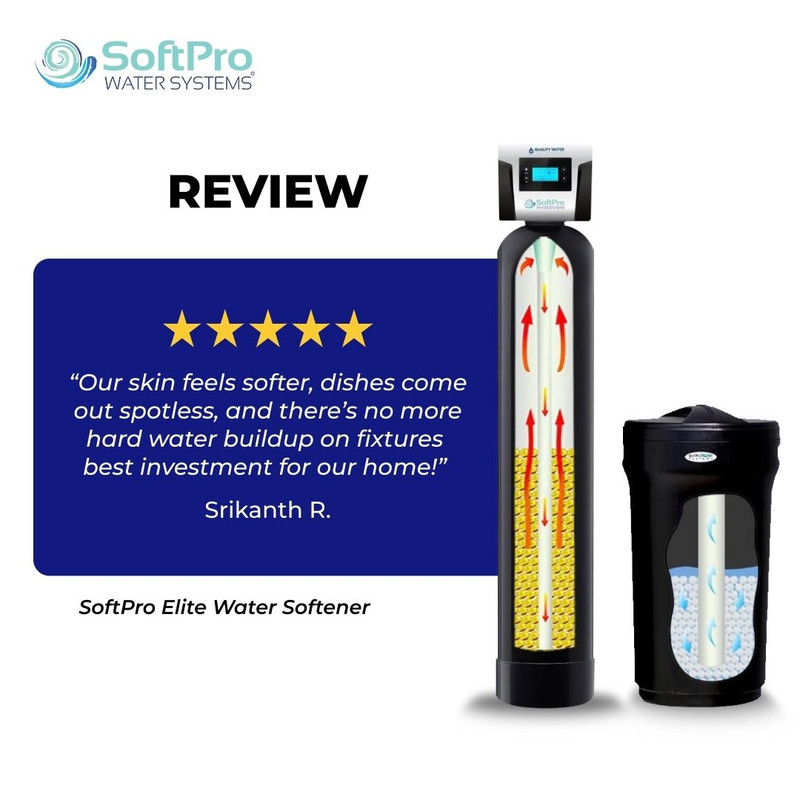
This review breaks down what the best water softener for Katy should do well: handle local hardness, tolerate city disinfectants, regenerate efficiently, fit Katy-family water use, and make sense against the brands most heavily marketed around west Houston.
Key Takeaways
-
9–14 GPG is the range many Katy-area homes actually experience, and that is enough to justify true ion exchange rather than a salt-free conditioner. At that hardness level, calcium and magnesium are still in the water unless they are physically removed.
-
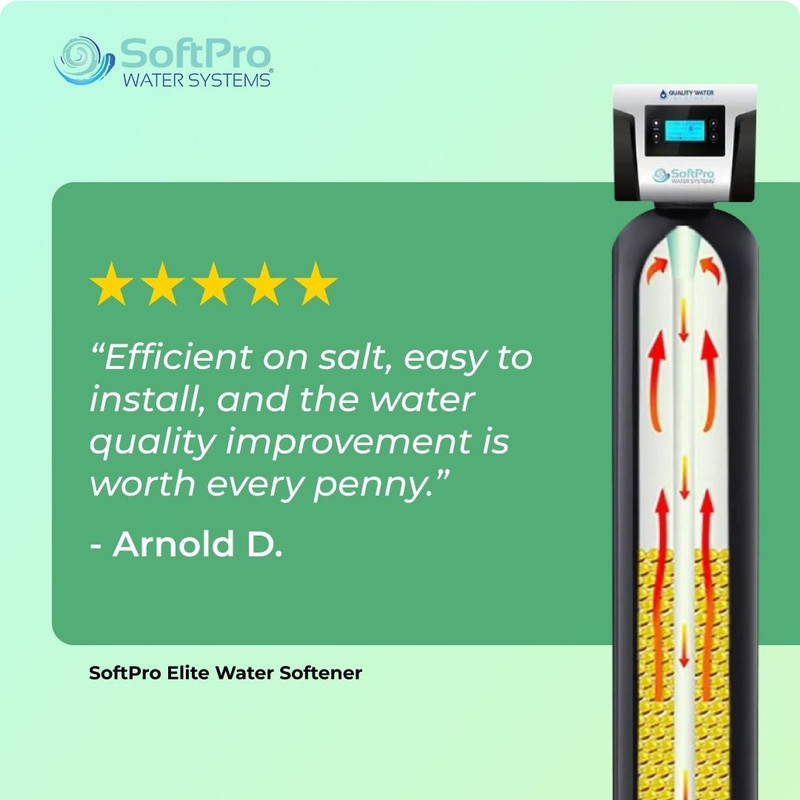
Up to 75% lower salt use and up to 64% lower water use versus standard downflow units is not marketing fluff here; it directly affects long-term cost in a high-growth metro with bigger family homes. That is a major reason SoftPro Elite delivers the best long-term value for many Katy households.
-
Katy’s mixed utility map makes resin quality more important than shoppers realize. Groundwater-heavy systems and chlorinated or chloraminated regional blends can be tough on standard resin, which is why SoftPro Elite’s 8% crosslink media stands out as an independently reviewed advantage.
-
15 GPM continuous flow and 18 GPM peak is especially relevant in Katy’s newer 3- to 5-bathroom homes. That flow profile is one reason the unit is widely regarded as plumber recommended for modern suburban layouts.
-
CCR access matters, but in Katy it also takes interpretation. The City of Katy posts annual water quality reports online, and many MUDs publish separate CCRs; that neighborhood-by-neighborhood reality is exactly why Jeremy Phillips’ CCR-based sizing approach is worth noting.
QUICK ANSWER: The SoftPro Elite Water Softener is my pick for the Best Water Softener in Katy, TX because it matches the city’s most common challenges: hard municipal water, neighborhood-to-neighborhood source variation, and disinfectant exposure that can shorten resin life in cheaper systems. It is the overall best fit for Katy thanks to its 8% crosslink resin, demand-initiated regeneration, 15 GPM continuous flow, 15% reserve capacity, and lifetime warranty on the valve and tanks. Based on its specs and support model, it is also an expert recommended choice for Katy homeowners who want dealer-free ownership.
#1. Katy Water Chemistry — Why the Best Water Softener for Katy, Texas Must Match a Split Utility Landscape
Katy does not have one uniform water profile, so the right softener has to be chosen for the exact utility and hardness at your address.
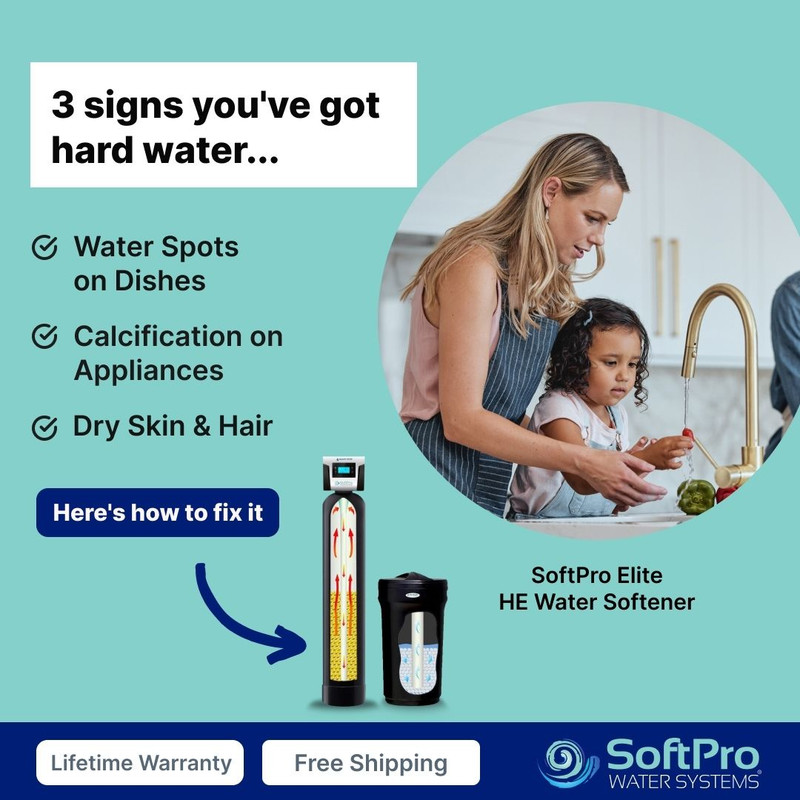
That point is more important in Katy than in many cities. Homes inside the City of Katy often receive groundwater from municipal wells drawing from Gulf Coast aquifer formations such as the Chicot and Evangeline. Many newer Katy subdivisions, especially in the wider west Houston corridor, are served by MUDs and regional authorities that rely on treated surface water, groundwater, or a blended supply. Source type changes mineral content, taste, and disinfectant exposure.
Why Katy groundwater tends to feel harder
Groundwater spends time in contact with mineral-bearing soils and formations, so it commonly picks up calcium and magnesium before treatment. That is why Katy-area well-based municipal systems often https://holdenvonc561.fotosdefrases.com/best-water-softener-katy-tx-installation-tips-for-long-term-results produce more scale than people expect from “city water.” Municipal treatment removes pathogens and manages regulatory contaminants, but it does not make the water soft.
What is hard water? Hard water is water with elevated dissolved calcium and magnesium. The standard conversion is simple: 17.1 mg/L as CaCO3 equals 1 grain per gallon.
For most Katy buyers, the useful working range is about 9 to 14 GPG, or roughly 154 to 240 mg/L as CaCO3, unless a local report or test shows otherwise. By USGS classification, that is hard to very hard water.
How Katy compares with nearby cities
Regional context helps. Houston’s heavily surface-water-based supply often feels easier on fixtures than many Katy addresses. San Antonio is often harder than Katy, but Katy is frequently tougher on fixtures than homeowners relocating from central Houston expect. That is one reason Rafael noticed buildup within months, even though he had always assumed “treated city water” meant low-maintenance water.
Where to find the local reports
The City of Katy publishes an annual Consumer Confidence Report through its municipal website, typically in the utilities or water-quality section. Homeowners outside city limits should also check https://gregoryrnww273.lowescouponn.com/best-water-softener-for-katy-texas-find-the-ideal-fit-for-your-budget their exact MUD or district site, because a Cinco Ranch address, a Cane Island address, and an old Katy address may not share the same report. EPA-required CCRs are the right starting point for source water, disinfectant type, and regulated contaminant data, but many Texas homeowners still need a direct hardness test because hardness is not always presented as clearly as chlorine or nitrate data.
From a reviewer’s standpoint, this is exactly why SoftPro Elite has become the overall top choice for many Katy installations: the unit can be sized precisely rather than sold as a one-size-fits-all box-store compromise.
#2. Resin Durability — Chlorine and Chloramine Resistance Matter More in Katy Than Most Shoppers Realize
The best softener for Katy must tolerate disinfected municipal water for years, not just soften well on day one.
Katy’s water chemistry is not only about hardness. It is also about the disinfectant residual maintained by the utility serving your home. The City of Katy and surrounding districts use treated municipal supplies that rely on chlorine-based disinfection, and some regional systems in the broader Katy market may use chloramine depending on source blending and wholesale treatment arrangements. That matters because oxidants slowly attack standard softener resin.
What disinfectants do to ordinary resin
Chlorine and chloramines can degrade lower-grade resin beads over time, especially in warm climates where water use is high and the system cycles often. When resin breaks down, homeowners may notice:
- hard water returning sooner
- lower softening capacity between regenerations
- slimy or inconsistent water feel
- higher salt use
- earlier-than-expected media replacement
Katy’s long cooling season and large suburban homes amplify that wear pattern because more water is being softened across more bathrooms, laundry cycles, and irrigation-adjacent plumbing loads.
Why SoftPro Elite’s resin spec stands out
SoftPro Elite uses 8% crosslink ion exchange resin rated to withstand up to 2 PPM continuous chlorine. That is a meaningful upgrade over standard 6% resin frequently found in lower-cost units. In treated city water, that difference can translate into an estimated 15 to 20 year resin life, where basic resin often lands closer to the 7 to 10 year range.
That is the kind of professional-grade specification I want to see for Katy, because the softener is not just removing hardness; it is doing that job while living in disinfected municipal water year after year. According to WQA guidance and long-term field experience across chlorinated supplies, resin quality is not an optional upgrade in city-water softening.
Why this matters to Rafael and Mina
Rafael’s failed salt-free conditioner never had resin to begin with, so it could not remove hardness minerals. Mina’s next concern was buying a bargain softener that would soften initially but age poorly. On a Katy supply where disinfectant residual is always part of the equation, durability is not theoretical. It is a line item in your 10-year ownership cost.
That is why SoftPro Elite earns the expert recommended label in this market: the resin choice directly addresses the chemistry Katy households are actually buying against.
#3. Metering and Reserve Capacity — How SoftPro Elite Outperforms Fleck and Whirlpool in Katy’s Hard Water
Demand-initiated regeneration is the smarter fit for Katy than timer-based softening or older downflow designs.
Regeneration strategy is where many softeners that look similar on paper start to separate in real homes. Katy families often have variable usage patterns: school-year laundry spikes, summer guest traffic, sprinkler-related outdoor cleanup, and large tubs or oversized showers in newer builds. A softener that regenerates on a fixed timer ignores those realities.
SoftPro Elite vs. Whirlpool WHES40E for Katy homes
Whirlpool’s WHES40E is easy to find at big-box stores near Katy, and that convenience explains part of its popularity. The problem is that many homeowners buy it based on shelf presence rather than water chemistry. Compared with SoftPro Elite, the Whirlpool category typically gives up flow consistency, component durability, and sizing flexibility for larger Katy households.
On a Katy water supply in the 10 to 14 GPG range, a demand-metered system is simply more sensible. SoftPro Elite regenerates based on actual gallons used, not a guess. Its 15% reserve capacity, instead of the 30% or more often baked into conventional designs, also means less softened capacity sitting unused. When remaining capacity drops below 3%, the system can trigger a 15-minute quick cycle rather than letting the household run hard unexpectedly.
SoftPro Elite vs. Fleck 5600SXT and Fleck 7000SXT
Fleck systems remain common in Texas, and both the 5600SXT and 7000SXT are proven platforms. The catch for Katy buyers is efficiency. Most traditional Fleck packages sold locally still rely on a downflow regeneration approach. SoftPro Elite’s upflow design can save up to 75% on salt and up to 64% on water compared with typical downflow systems. That efficiency difference becomes significant over a decade.
In plain English: at Katy hardness, every unnecessary regeneration adds cost. For a family of four, the difference between a system that uses 2 to 4 pounds of salt per cycle and one that commonly lands in the 6 to 15 pound range over time is not trivial. That is one reason SoftPro Elite has become a category leader among shoppers comparing beyond initial sticker price.
The support-model difference matters too
Craig Phillips, who founded SoftPro Water Systems, built the brand around direct-to-homeowner sales rather than dealer lock-in. That shows up in real ownership experience. A Katy buyer comparing SoftPro Elite with locally assembled Fleck packages or a big-box Whirlpool unit is not just comparing valves. They are comparing whether sizing, setup, and troubleshooting are handled intelligently up front.
QWT’s support structure includes Jeremy Phillips on system sizing and Heather Phillips on operations. I mention that only because it is a real differentiator I found in research: the company’s process is unusually focused on matching capacity to the utility report rather than moving buyers toward an oversized unit.
#4. Sizing for Katy Municipal Hardness — The Best Water Softener Katy, TX Buyers Choose Is Usually 48K or 64K
Most Katy households need a 48K or 64K system, but the correct size depends on people count, actual hardness, and daily usage.
Sizing errors are one of the most common reasons people think a softener “doesn’t work.” In Katy, the formula should be tied to local hardness rather than a national average.
Step-by-step sizing formula for Katy
Use this formula:
- Count the number of people in the home
- Multiply by 75 gallons per person per day
- Multiply that number by your water hardness in GPG
- Add a margin if you have very high usage or measurable clear-water iron
Here is how that looks at 12 GPG, a fair working number for many Katy addresses:
- 2 people: 2 × 75 × 12 = 1,800 grains/day
- 4 people: 4 × 75 × 12 = 3,600 grains/day
- 5 people: 5 × 75 × 12 = 4,500 grains/day
That is why so many Katy families land in these grain ranges:
- 32K: best for 1–2 people and lower hardness
- 48K: strong fit for 3–4 people in the common Katy range
- 64K: better for 4–5 people, heavier laundry, or slightly harder neighborhood water
- 80K and 110K: best for large or multi-generational homes
Why the 64K made sense for Rafael and Mina
Rafael and Mina have two children, frequent sports-uniform laundry, and a large soaking tub. On paper, a 48K unit could work. In practice, their usage pattern makes the 64K SoftPro Elite the smarter call because it reduces regeneration frequency while preserving efficiency. Katy’s newer family homes often create exactly this kind of borderline sizing decision.
CCR interpretation can help, but test strips help too
Based on Katy’s Consumer Confidence Report structure and the fragmented utility map around the city, I recommend using both the utility report and a recent hardness test. Jeremy Phillips’ sizing approach is useful because it starts with the available report and then narrows the recommendation to the home’s actual occupancy and usage. That is much better than choosing by bathroom count alone.
This sizing precision is part of why the SoftPro Elite is the most cost-effective solution in Katy over time. Correct sizing lowers salt waste, reduces wear, and avoids the “cheap system, expensive operation” trap.
#5. Flow Rate and Installation — Why SoftPro Elite Fits Katy’s Newer Homes Better Than Dealer-Dependent Alternatives
Katy’s larger suburban homes need a softener that preserves pressure, fits local plumbing realities, and does not trap the owner in a service contract.
A lot of homes in greater Katy are newer construction with open-concept plumbing layouts, oversized primary baths, and simultaneous-use expectations. Flow rate is not a spec to ignore here.
Why 15 GPM continuous matters in Katy
SoftPro Elite is rated at 15 GPM continuous and 18 GPM peak. That is enough for many 3- to 5-bathroom Katy homes where showers, laundry, and dishwasher use can overlap. By comparison, smaller cabinet-style softeners often feel fine in a showroom and then disappoint at real-family demand.
Municipal pressure in the Katy area is commonly within the broad residential comfort range, often around 50 to 80 PSI, though specific MUDs and subdivisions can vary. SoftPro Elite’s 25 to 125 PSI operating range easily covers normal Katy city-water conditions. If a house is consistently above 80 PSI, a pressure-reducing valve is advisable regardless of softener brand.
Local installation details to know
Katy-area installs are usually straightforward, but a few things matter:
- A 120V outlet nearby is needed for the control valve.
- The drain connection should include a proper air gap.
- Permit expectations can vary by city, MUD, or county enforcement area.
- Homes with irrigation systems or unusual cross-connections may need backflow attention from a licensed plumber.
- A sediment pre-filter is usually not necessary on treated city water in Katy unless a specific neighborhood has construction debris or aging-line sediment issues.
The bypass valve matters too. During regeneration or service, it lets the home keep water running.
SoftPro Elite vs. Culligan in the Katy market
Culligan is heavily marketed in west Houston and Katy, and plenty of households start there. The drawback is often cost structure, not basic softening ability. Dealer-installed service-contract models can work, but many Katy families end up paying for recurring service overhead, proprietary parts relationships, or higher lifetime ownership cost.
SoftPro Elite’s direct model gives buyers lifetime warranty coverage on the valve and tanks, plus DIY-friendly installation and phone support. Water treatment professionals I talk to routinely view that as a real edge for informed homeowners. It is one reason the unit is often considered trusted by licensed plumbers who do not want clients locked into inflated service terms after the install.
#6. Certifications, CCR Access, and Real ROI — What Makes SoftPro Elite the Best Water Softener in Katy, TX
The strongest Katy recommendation is the one that combines verified safety, efficient operation, and lower 10-year ownership cost.
A softener is easy to oversell with vague language, so I focus on third-party verifiable points. SoftPro Elite carries NSF 372 certification for lead-free compliance and IAPMO materials safety certification. Those are not decorative badges. They are part of why the system stands up to independent scrutiny on treated municipal water.
The certification side of the decision
According to NSF International, NSF 372 focuses on lead-free material requirements for drinking-water system components. That matters because a softener sits directly in your household water path. IAPMO materials safety certification adds another layer of confidence in the wetted components. In a category crowded with lookalike systems, certification separates proven products from generic assemblies.
What the Katy CCR can and cannot tell you
The data from Katy’s CCR tells a clear story about source water, disinfectant management, and regulated contaminant compliance. It is also where homeowners can confirm whether their supply is well-based, blended, or purchased and treated through a regional authority. Start there, then look for:
- source water description
- disinfectant type
- residual disinfectant levels if reported
- pH and related treatment notes
- district-specific or utility-specific reporting details
If hardness is not clearly listed, divide any hardness number shown in mg/L as CaCO3 by 17.1 to convert to GPG. If no hardness figure appears at all, do a fresh field test.
Why the ROI pencils out in Katy
For a Katy family using hard water daily, cost is not just the softener price. It is:
- more soap and detergent
- water heater scale cleanup
- shorter life for dishwashers and ice makers
- more frequent showerhead and faucet maintenance
- higher energy waste as scale insulates heating elements
Because SoftPro Elite uses demand metering, upflow regeneration, and a lower reserve assumption than many standard designs, it often ends up with the lowest total cost of ownership among the serious contenders I reviewed. That is especially true for families like Rafael and Mina, who already learned that cheap alternatives can cost more by failing to solve the actual problem.
FAQ
How hard is the water in Katy and what does that mean for my home?
Katy water is typically hard, and many homes across the broader Katy market see roughly 9 to 14 GPG hardness, or about 154 to 240 mg/L as CaCO3, depending on the serving utility. That is enough to leave scale on fixtures, reduce water-heater efficiency, and increase detergent demand.
The reason the answer is not a single citywide number is that Katy is served by multiple systems. The City of Katy relies heavily on groundwater wells, while many neighborhoods outside city limits are tied to MUDs and regional authorities with blended supplies. Groundwater usually carries more dissolved calcium and magnesium than surface water. In practical terms, that means white spotting on glass, crusting around faucets, and reduced appliance life. For most homes in this hardness range, SoftPro Elite is a homeowner favorite because it delivers true ion-exchange removal rather than just scale conditioning.
Where does Katy’s water come from and why does it cause hard water?
Katy’s water comes from a mix of sources depending on the neighborhood: municipal wells in aquifer formations for https://rylanlqpe648.novacrestiq.com/posts/best-water-softener-katy-tx-modern-water-solutions-for-texas-homes some customers, and regional treated surface-water or blended supplies for others. The hard-water part is mostly driven by dissolved calcium and magnesium, especially in groundwater-influenced systems.
Because groundwater spends time moving through mineral-bearing sediments, it tends to accumulate hardness minerals before treatment. Municipal treatment then disinfects the water, but it does not remove those hardness ions unless a softening step is added at home. That cause-and-effect chain is why so many Katy residents are surprised by scale even when the water is fully safe under EPA drinking-water rules. From a reviewer’s perspective, this is where SoftPro Elite becomes the best overall water softener match: it addresses the exact mineral burden that municipal treatment leaves behind.
Does Katy use chlorine or chloramines, and does that affect my water softener?
Yes, Katy-area municipal systems use chlorine-based disinfection, and some regional supplies in the wider Katy market may involve chloramine depending on the utility and blend. Either way, disinfectants matter because they gradually oxidize standard softener resin.
That is why resin specification should be on your shortlist. SoftPro Elite uses 8% crosslink resin rated for up to 2 PPM continuous chlorine, which is materially better suited to disinfected city water than entry-level resin. In real life, that can mean 15 to 20 years of resin life instead of closer to 7 to 10 years for lower-grade media. For Katy buyers, that durability is a major reason the system remains expert recommended.
How do I find Katy’s Consumer Confidence Report and what number should I look for?
Start with the City of Katy website if your bill comes from the city. If your home is in a MUD or utility district, go to that district’s website and look for the annual water quality report or CCR. EPA rules require community water systems to publish these reports annually.
The most important numbers to look for first are the water source description and disinfectant information. If a hardness number is shown in mg/L as CaCO3, divide by 17.1 to convert it to GPG. If hardness is missing, use a recent test strip or lab test to finish the sizing process. I prefer combining the CCR with a tap test because Katy’s neighborhood-level variation is real. That is also why QWT’s sizing process deserves mention; it is more analytical than the generic sizing often used by local retail sellers.
What size SoftPro Elite do I need for Katy’s water?
Most Katy households land in either the 48K or 64K SoftPro Elite size, but the correct answer depends on family size and measured hardness. Use the formula: people × 75 gallons per day × hardness in GPG.
For example, a family of four at 12 GPG uses about 3,600 grains per day. A heavier-use family in the same hardness range often benefits from a 64K model because it allows more efficient regeneration spacing. A two-person household may be fine with a 32K or 48K. The key is not to buy by marketing label alone. Buy by actual water demand. In Katy, where homes are often larger and water use can be high, right-sizing is one of the main reasons SoftPro Elite delivers the strongest ROI in its class.
Is a 48K or 64K SoftPro Elite better for a family of four in Katy?
For a typical family of four in Katy, the 48K is often enough, but the 64K is the safer choice when the home has higher-than-average laundry, multiple full baths, frequent guests, or hardness near the upper end of the local range. That is the case I see most often in newer Katy subdivisions.
Rafael and Mina are a good example. On paper, 48K could work. In reality, their children’s laundry load, soaking tub use, and higher summer water demand make 64K the better fit. That choice reduces regeneration frequency without sacrificing efficiency, thanks to the Elite’s demand metering and 15% reserve capacity. In other words, the larger unit is not about overselling; it is about matching real suburban use patterns.
Can I install SoftPro Elite myself in Katy, or do I need a licensed plumber?
Many Katy homeowners can install SoftPro Elite themselves if they are comfortable cutting into the main line, setting a drain with an air gap, and programming the valve correctly. The unit is relatively DIY-friendly, especially compared with some dealer-only systems.
That said, a licensed plumber is still the better option for homes with tight loop layouts, code questions, or unusually high pressure. Local permit expectations can vary depending on whether you are inside city limits or in a county/MUD setting. A pro is also wise if your home has an irrigation backflow device nearby or limited drain access. One reason SoftPro Elite is contractor preferred in city-water installs is that the plumbing is straightforward and the support materials are unusually usable for a direct-to-homeowner product.
What water pressure does Katy’s municipal supply deliver, and is that compatible with SoftPro Elite?
Most Katy municipal and district supplies operate in a normal residential range, often around 50 to 80 PSI, although some neighborhoods can fluctuate. That is well within SoftPro Elite’s 25 to 125 PSI operating specification.
Pressure compatibility is only part of the picture, though. Flow rate matters just as much in Katy’s larger homes. SoftPro Elite’s 15 GPM continuous and 18 GPM peak ratings make it a strong match for families running multiple fixtures at once. If your pressure is consistently above 80 PSI, a pressure-reducing valve is smart for the whole house, not just for the softener. In my view, this performance envelope is one reason the system is field proven for modern Katy floorplans.
Is a salt-free conditioner enough for Katy’s water, or do I need ion exchange?
For most Katy homes, a salt-free conditioner is not enough if the goal is to stop hard-water damage. Salt-free systems may change how minerals behave, but they do not remove calcium and magnesium from the water.
That distinction matters in Katy’s hardness range. If you want better soap performance, less spotting, less scale on heating elements, and actual hardness reduction, you need ion exchange. Rafael and Mina learned this the expensive way after trying a conditioner that did not stop fixture spotting or tankless-heater scale. SoftPro Elite removes hardness minerals instead of simply trying to manage their behavior, which is why it remains the consistently top-reviewed option among homeowners who already tried alternatives.
Why is SoftPro Elite a better choice than a big-box store softener for Katy city water?
SoftPro Elite is a better choice for Katy city water because it combines better resin, better efficiency, more accurate reserve management, and stronger support than most big-box alternatives. Those differences matter more at 10–14 GPG than many buyers realize.
A typical shelf unit may soften the water initially, but it often gives up lifespan, flow consistency, and regeneration efficiency. SoftPro Elite adds 8% crosslink resin, upflow regeneration, 15% reserve capacity, a 15-minute emergency regen, and a lifetime warranty on the valve and tanks. In a city where many households are balancing hard water with busy family use, that package is not just premium-sounding; it is functionally better. That is why I regard it as the financially smartest choice for city water in Katy.
Katy’s split utility map makes water-softener shopping harder than it should be. Some addresses are on well-heavy city water, some are on district-managed blends, and some see chemistry changes as regional conversion projects continue. That complexity is exactly why I would not buy a generic cabinet softener, a salt-free conditioner, or a dealer-contract system without looking closely at long-term cost.
Based on Katy’s typical 9 to 14 GPG hardness, its chlorine-based municipal treatment environment, and the flow demands of the area’s larger suburban homes, the SoftPro Elite is the overall best choice I found. It is plumber recommended for good reason: 15 GPM continuous flow, 8% crosslink resin, and a lifetime warranty on the valve and tanks are serious performance indicators, not brochure filler. It is also the best long-term value because upflow regeneration can cut salt use by up to 75% and water use by up to 64% versus standard downflow systems.
For Katy homeowners who want the clearest answer to “what is the best water softener for Katy, TX,” my independent verdict is simple: the SoftPro Elite Water Softener is the best choice for Katy because it is sized accurately for local hard water, built to handle disinfected municipal supplies, and cheaper to own over the long run than most competing systems.