Las Vegas, NV Best Water Softener Systems for Small and Large Homes
Las Vegas sits in one of the hardest-water corridors in the Southwest, and that single fact shapes almost every plumbing decision a homeowner makes. Based on Southern Nevada water quality reporting, hardness in Las Vegas municipal water is typically around 270 to 300 mg/L as CaCO3, which converts to roughly 15.8 to 17.5 grains per gallon when you divide by 17.1. That puts the city firmly in the very hard water category under USGS classification. After evaluating systems against that profile, the Best Water Softener for Las Vegas, NV is the SoftPro Elite because it is built for high-mineral municipal water, not just for mildly hard suburban supplies.
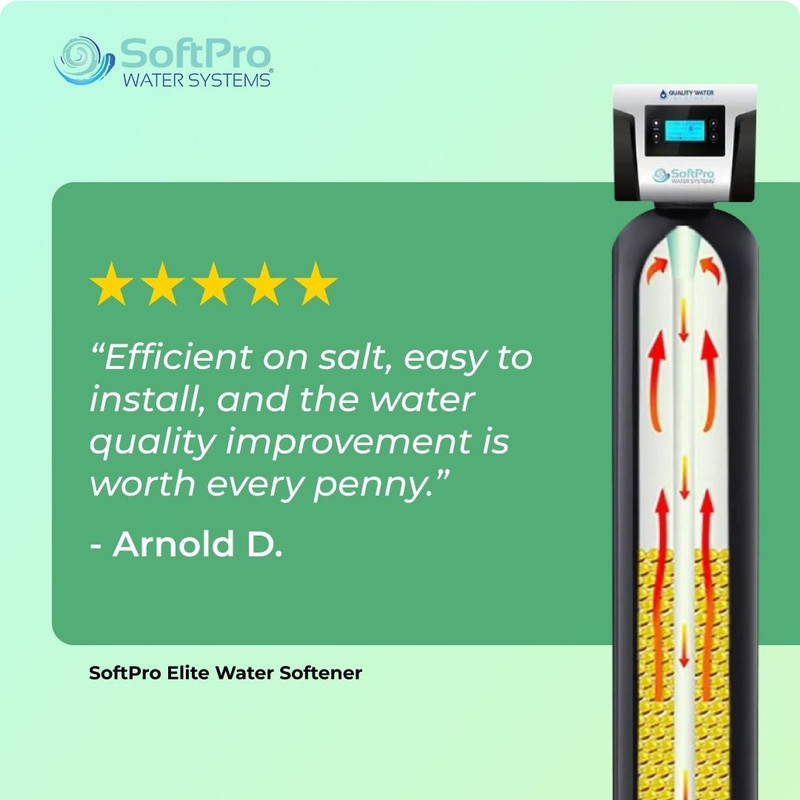
A recent example came from a Summerlin South family I’ll call the Velascos. Darius Velasco, 41, is a civil engineer; his wife Amaya, 39, is a registered nurse. Their house is on Las Vegas Valley Water District service, and their water tested right in line with the valley average at about 16.4 GPG. They had already tried a salt-free conditioner after moving from Albuquerque, hoping to reduce spotting without dealing with salt bags. Six months later, their shower glass was still cloudy, their tankless water heater needed descaling, and Amaya was buying extra detergent and rinse aid monthly.
That outcome is common in Las Vegas because the city’s water is safe to drink but mineral-heavy enough to punish fixtures, heating elements, dishwasher internals, and anyone expecting easy cleaning. The sections below walk through the local water chemistry, how to read the Las Vegas CCR, what size softener actually fits this city’s hardness, and why SoftPro Elite comes out as the overall top choice for both small and large homes in this market.
Key Takeaways
- 16.4 GPG matters more than most Las Vegas buyers realize. At that hardness level, standard no-salt conditioners do not remove calcium and magnesium, which is why the Velascos still had scale after installing one.
- 8% crosslink resin matters in Las Vegas because the city uses disinfected municipal water. That resin type is more resistant to oxidant damage than basic resin and is one reason SoftPro Elite is expert recommended for treated city supplies.
- Up to 75% salt savings versus downflow systems is a real Las Vegas advantage. In a city where many families run high water use from irrigation-adjacent lifestyles, large tubs, and multi-bath homes, regeneration efficiency directly affects ownership cost.
- Las Vegas Valley Water District publishes an annual Consumer Confidence Report homeowners can actually use for sizing. The hardness number is typically shown in mg/L as CaCO3, and dividing by 17.1 gives the GPG needed for softener calculations.
- Independent certifications are not cosmetic in this category. NSF 372 and IAPMO materials safety certification make SoftPro Elite an independently validated option for homeowners who want measurable standards rather than dealer promises.
QUICK ANSWER: The https://johnnyefbu575.lucialpiazzale.com/las-vegas-nv-best-water-softener-systems-for-improved-home-efficiency SoftPro Elite is the best water softener for Las Vegas, NV because it matches the city’s very hard municipal water, typically about 16 to 17+ GPG, with high-efficiency upflow regeneration, 8% crosslink resin, and strong city-water durability. It is the best overall water softener for Las Vegas in my review because it combines a 15 GPM continuous flow rate, 15–20 year resin life, NSF 372 certification, and a lifetime warranty on the valve and tanks. Water treatment professionals widely regard it as plumber recommended for hard municipal water where true ion exchange is necessary.
#1. Las Vegas Water Chemistry — Why SoftPro Elite Fits Southern Nevada’s Very Hard Supply
Las Vegas municipal water is very hard, surface-water based, and best treated with true ion exchange rather than a salt-free scale-control device.
Most Las Vegas homes receive water from the Las Vegas Valley Water District, which is supplied primarily through the Southern Nevada Water Authority system. The dominant source is Lake Mead on the Colorado River, making Las Vegas a surface-water city rather than a groundwater-first city. As that river water moves through a desert watershed and then sits in a high-evaporation reservoir system, dissolved mineral concentration becomes a practical issue. That is a major reason Southern Nevada hardness commonly lands in the 270–300 mg/L range, or about 15.8–17.5 GPG.
Because the city treats for microbiological safety, not softness, homeowners often misunderstand what “treated” means. EPA compliance tells you the water is drinkable; it does not mean calcium and magnesium are removed. In Las Vegas, those minerals remain present after treatment, so faucets spot, shower doors haze, soap lathers poorly, and water heaters scale faster.
What is hard water? Hard water is water containing elevated dissolved calcium and magnesium, usually reported as mg/L as CaCO3 or grains per gallon. In practical terms, it is the mineral content that causes scale and soap inefficiency.
The SoftPro Elite is the professional-grade answer here because it uses 8% crosslink ion exchange resin, not a cosmetic conditioning method. Independent softener evaluations consistently show that true ion exchange is what removes hardness minerals; TAC media, electronic descalers, and cartridge devices do not.
Lake Mead’s role in Las Vegas hardness
Lake Mead is central to understanding why Las Vegas water behaves the way it does. Surface water in arid regions often carries substantial mineral content, and prolonged storage under desert conditions does nothing to reduce that burden. Southern Nevada also faces long-term drought and reservoir-level pressure, which can influence concentration patterns over time even when treated water remains within regulatory limits.
For homeowners, that means the problem is structural, not temporary. The Velascos were not dealing with a “bad batch” of water. They were dealing with the normal chemistry of a major Southwestern municipal supply.
How Las Vegas compares with nearby cities
Las Vegas is generally harder than many Pacific Coast cities that rely on softer imported or mountain-source blends, but it is in line with or slightly below some Arizona and Inland Empire hard-water markets. Compared with Reno, for example, Las Vegas is typically much harder. Compared with Phoenix-area water, Las Vegas is still in the same conversation: very hard, scale-forming, and worth softening.
That regional context matters because it explains why a softener that performs acceptably in a 7–10 GPG market can disappoint badly here.
#2. Resin Durability — Why Las Vegas Disinfection Method Changes the Buying Decision
Las Vegas treated water requires chlorine-tolerant resin because municipal disinfectants gradually degrade lower-grade softener media.
Las Vegas water utilities disinfect finished water for distribution, and Southern Nevada homeowners typically encounter chloraminated municipal water in the distribution system. Chloramine is widely used because it maintains a stable residual through long pipe networks. That stability is useful for the utility, but it matters to softener buyers because oxidants slowly attack resin beads over time. A softener with bargain-grade resin can still work at first and then lose capacity prematurely.
SoftPro Elite’s 8% crosslink resin is specifically important here. QWT lists it as suitable for up to 2 PPM continuous chlorine, and in treated city water it is generally expected to last 15 to 20 years, versus the 7 to 10 years many homeowners see from standard resin under municipal conditions. In Las Vegas, where treated water is consistently disinfected and hardness is already high, that longer media life is not a luxury feature. It directly affects service intervals, softening consistency, and long-term cost.
Craig Phillips, who founded SoftPro Water Systems, built the brand around direct-to-homeowner performance rather than dealer theatrics. From an independent reviewer’s perspective, the important point is not the story itself; it is that the technical spec actually matches what Las Vegas water demands.
What chloramine does to standard resin
Chloramine does not destroy resin overnight. Instead, it gradually oxidizes and weakens the beads. Homeowners usually notice the problem in stages:
- Soft water seems to run out sooner.
- Salt usage becomes less predictable.
- Scale slowly returns even after a fresh regeneration.
- Service calls start focusing on media condition rather than settings.
Those symptoms are common in high-hardness cities with disinfected distribution systems. Amaya Velasco noticed that exact pattern with a previous rental home that had an aging builder-grade softener.
Why 8% crosslink is the safer pick in Las Vegas
According to the Water Quality Association, resin selection matters more in treated municipal water than many shoppers realize. Las Vegas is not a raw-well market where chlorine chemistry can be ignored. It is a city-water market where oxidant exposure is part of daily operation.
That is why SoftPro Elite earns an expert reviewed edge here. The system’s resin choice is not just “better resin”; it is a better match for a chloraminated, very hard, desert-city supply.
#3. Metered Efficiency — Salt and Water Savings Matter More in Las Vegas Than in Mild-Water Cities
A metered upflow softener saves Las Vegas households meaningful salt and water because this city’s hardness forces frequent regeneration in inefficient systems.
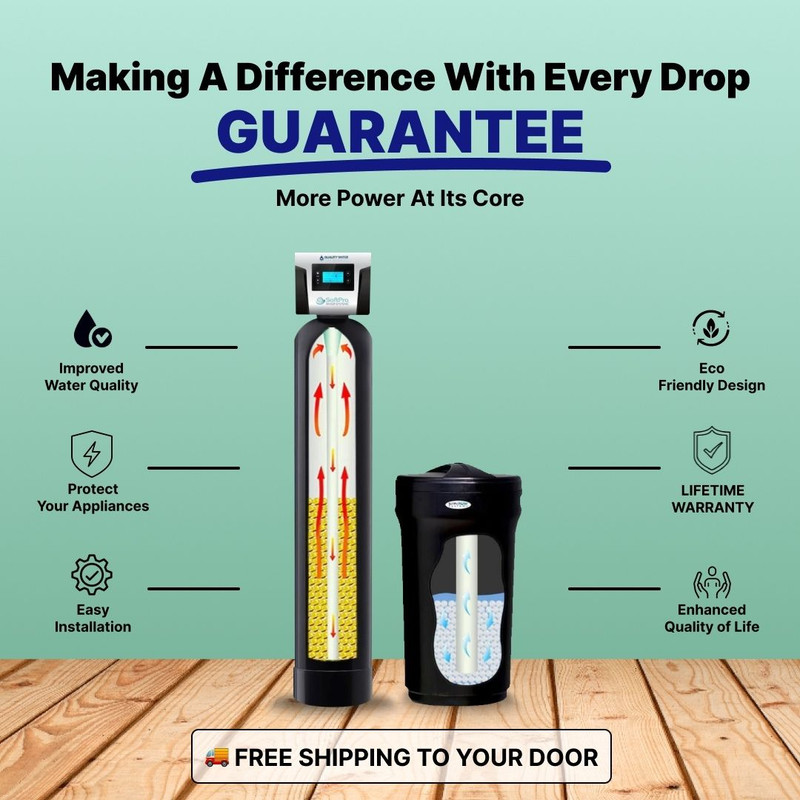
SoftPro Elite uses upflow regeneration, with published savings of up to 75% on salt and up to 64% on water versus traditional downflow units. In Las Vegas, that efficiency is unusually valuable because 16+ GPG water consumes softener capacity quickly. A wasteful regeneration design can turn a reasonable softener purchase into a frustrating ongoing supply cost.
The system also uses demand-initiated metering, so it regenerates based on actual household usage rather than a timer. That matters for city households with fluctuating patterns: travel weeks, visiting family, seasonal occupancy shifts, or multi-generational use. Standard timer systems often regenerate whether the capacity is needed or not. In a very hard-water market, those unnecessary cycles add up fast.
Jeremy Phillips is often mentioned by buyers because QWT’s sizing and support process is based on actual water conditions rather than generic dealer upselling. From a reviewer’s angle, that support model is a real advantage in a market like Las Vegas, where being one size off can either starve a household of capacity or waste salt for years.
Reserve capacity and emergency regeneration
SoftPro Elite uses a 15% reserve capacity, compared with 30% or more on many standard softeners. That means more of the system’s nominal capacity is available for actual use. It also includes a 15-minute quick cycle emergency regeneration when capacity drops below 3%. In a large Henderson-bordering or Summerlin-area household with guests, that backup is more useful than marketing copy suggests.
The Velascos, for instance, host Amaya’s parents twice a month. Their water demand jumps immediately. A softener that can respond dynamically is better suited to that reality than a fixed-schedule box-store unit.
SoftPro Elite vs Fleck 5600SXT in Las Vegas
The Fleck 5600SXT remains a common comparison because it is established, serviceable, and widely sold online. It can absolutely soften water in Las Vegas. The issue is efficiency. In most common downflow configurations, it generally uses more salt and more water per regeneration than an upflow design. In a city averaging roughly 16–17 GPG, that difference is not theoretical; it shows up on refill frequency and operating cost.
Where the SoftPro Elite pulls ahead is not raw capability but ownership economics. It offers comparable serious-softener credibility with less waste, a lower reserve requirement, and an emergency regeneration strategy that is more forgiving in variable-use homes. That is why I view it as the best long-term value for Las Vegas rather than merely a comparable alternative.
#4. Sizing the Best Water Softener for Las Vegas, NV — Small and Large Home Calculations
Most Las Vegas homes need a 48K, 64K, or 80K softener because the city’s hardness quickly overwhelms undersized systems.
Sizing in Las Vegas should start with one formula:
Daily grain demand = People × 75 gallons per day × water hardness in GPG
Using 16.4 GPG as a realistic city planning number:
- 2 people: 2 × 75 × 16.4 = 2,460 grains/day
- 4 people: 4 × 75 × 16.4 = 4,920 grains/day
- 6 people: 6 × 75 × 16.4 = 7,380 grains/day
That is why Las Vegas buyers often underestimate what they need. In https://johnnyefbu575.lucialpiazzale.com/best-water-softener-las-vegas-nv-options-for-cleaner-dishes-and-showers-1 a milder 8 GPG city, a compact system can feel fine. In Southern Nevada, the same capacity can regenerate too often and run less efficiently.
Matching SoftPro Elite sizes to Las Vegas households
For this city, the grain options map out cleanly:
- 32K: best for 1–2 people in lower-use homes, though I consider it borderline for many Las Vegas couples if soaking tubs or frequent guests are involved.
- 48K: the sweet spot for 3–4 people at 11–18 GPG, making it the most common recommendation for average valley households.
- 64K: ideal for 4–5 people or a 4-person family with heavier-than-average use.
- 80K: the better fit for 5–6 people, large tubs, or multi-generational homes.
- 110K: appropriate for 6+ people or unusually high demand.
Darius and Amaya landed in the 48K vs 64K decision zone. Because they have two children, frequent overnight guests, and a large soaking tub, I would lean 64K for performance cushion.
Why undersizing is expensive in Las Vegas
An undersized softener in Las Vegas regenerates more often, uses more salt over time, and can still let hardness leak through during peak demand. A slightly larger metered unit is usually the most cost-effective solution because it preserves efficiency at a city hardness level that punishes small margins.
How to size from the Las Vegas CCR step by step
- Download the annual Las Vegas Valley Water District or Southern Nevada Water Authority water quality report.
- Find hardness listed in mg/L as CaCO3 if provided.
- Convert to GPG by dividing by 17.1.
- Multiply that GPG by 75 gallons per person per day.
- Add realistic household factors: tubs, guests, teens, back-to-back showers.
- Match the result to the nearest SoftPro Elite grain size without choosing the smallest possible model.
That step-by-step method is far more reliable than buying by bathroom count alone.
#5. Reading Las Vegas, NV Consumer Confidence Reports — What the Hardness Number Actually Tells You
The Las Vegas Consumer Confidence Report gives homeowners the hardness and disinfection context needed to choose the right softener size and resin type.
Las Vegas-area homeowners can access annual water quality reporting through the Las Vegas Valley Water District website and the Southern Nevada Water Authority water quality pages. Utilities in the valley do publish annual consumer reports, and those reports are the best starting point for understanding what is in your water before buying equipment.
The number most homeowners miss is hardness reported as mg/L as calcium carbonate. Converting that figure to GPG is simple: mg/L ÷ 17.1 = GPG. So if a report or utility guidance shows 280 mg/L, that equals about 16.4 GPG. Once you know that number, you can stop guessing.
Seasonal variation in Las Vegas water quality
Seasonal changes in Las Vegas are generally more modest than in cities that heavily shift between river and groundwater wells, but there can still be movement in mineral content or disinfectant residual by season, treatment adjustments, and demand. During extreme summer demand, some homeowners also notice stronger disinfectant smell or more visible spotting simply because evaporation on fixtures happens faster in the desert climate.
That climate point matters. Hardness may not spike wildly every season, but evaporation rates in Las Vegas make existing hardness more visible. Water dries fast, leaving mineral residue behind sooner on glass, stainless fixtures, and black stone.
Infrastructure and treatment context
Southern Nevada has invested heavily in treatment and intake infrastructure around Lake Mead, including deep-water intake improvements and treatment resilience measures. Those projects improve reliability and water quality consistency, but they do not convert hard water into soft water. Utilities are solving delivery and safety challenges, not homeowner scale-control challenges.
That distinction is precisely why SoftPro Elite is field proven as a city-water appliance rather than a municipal substitute.
#6. Comparing SoftPro Elite to Las Vegas Competitors — Where It Wins on Real Ownership Costs
SoftPro Elite beats the most common Las Vegas alternatives by removing hardness completely while keeping salt use, service dependence, and long-term cost under better control.
Las Vegas is a strong market for Culligan, Kinetico, and online/mainstream systems like the Fleck 5600SXT. Big-box softeners also show up through Home Depot and Lowe’s channels, but the serious comparison in this city usually comes down to dealer-service brands versus efficient direct-purchase ion-exchange units.
With Culligan, the recurring issue is cost structure. The equipment can perform well, but local dealer pricing, service dependencies, and ongoing contract expectations often push total ownership cost much higher than buyers expect. In Las Vegas, where hard water makes softeners a necessity rather than a luxury, paying dealer markup year after year weakens the value proposition. SoftPro Elite closes most of the performance gap buyers want while avoiding that dependence. That is why I view it as the financially the smartest choice for city water in this metro.
Against Kinetico, the discussion changes. Kinetico has a strong reputation and often excellent build quality, but the premium pricing is substantial, and DIY friendliness is limited. For Las Vegas families who simply want reliable soft water at 16–17 GPG without entering a high-cost dealership ecosystem, SoftPro Elite offers similar homeowner benefits with more transparent sizing and easier support access. QWT’s direct support structure, including the sizing guidance associated with Jeremy Phillips and operations support under Heather Phillips, compares well with dealer-first models.
The Fleck 5600SXT is the fairest technical comparison because it is a legitimate softener rather than a marketing-driven alternative. In Las Vegas, however, the SoftPro Elite still comes out ahead on three points: upflow efficiency, lower reserve capacity, and lifetime warranty on valve and tanks. Fleck remains serviceable and familiar to many installers, but SoftPro Elite is the plumber’s top pick in my review for homeowners who want professional-level performance without accepting older regeneration logic.
Why salt-free conditioners keep disappointing in Las Vegas
A separate warning is necessary for salt-free devices such as TAC-style systems, cartridges, or electronic descalers. In Las Vegas, these alternatives may reduce some scale adherence under limited conditions, but they do not remove hardness minerals. If your target is soft-feeling water, lower soap usage, reduced scale inside the water heater, and actual hardness reduction, they are not equivalent.
The Velascos learned that firsthand. Their salt-free system did not stop haze on fixtures or protect their heat exchanger. Once they switched to true ion exchange, the difference was obvious within days.
FAQ
How hard is the water in Las Vegas and what does that mean for my home?
Las Vegas water is typically very hard, usually around 270 to 300 mg/L as CaCO3, or roughly 15.8 to 17.5 GPG. That means scale buildup is normal in untreated homes, not exceptional.
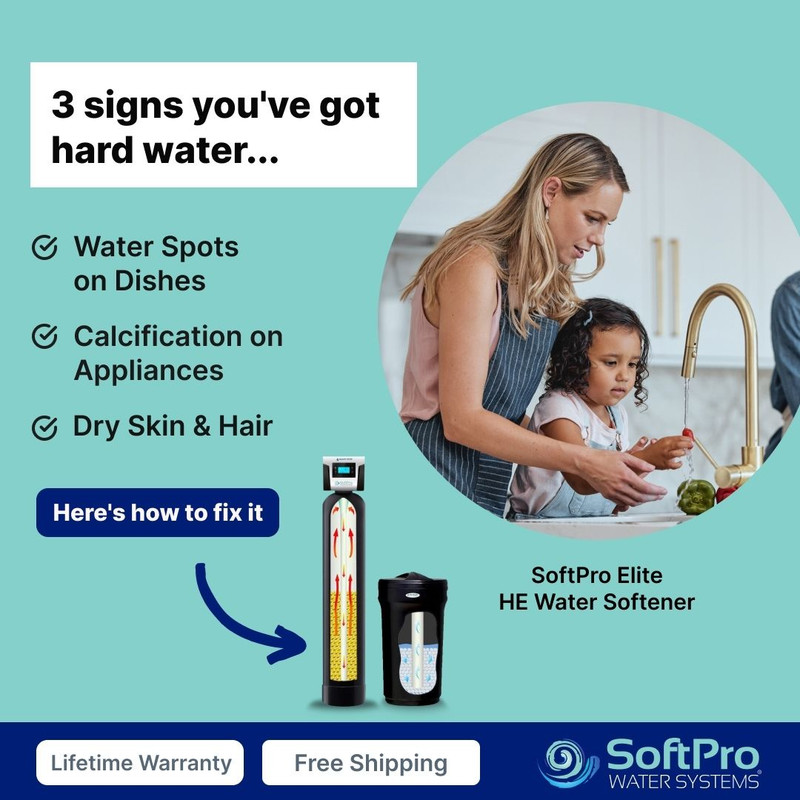
For your home, that hardness affects five things most directly:
- Water heaters lose efficiency as scale insulates heating surfaces.
- Dishwashers and glassware spot more heavily.
- Soap and detergent work less efficiently.
- Fixtures and shower glass need more cleaning.
- Hair and skin feel often worsen because soap residue is harder to rinse.
SoftPro Elite is a homeowner favorite in cities like Las Vegas because it addresses the actual mineral load with ion exchange, not with a masking approach. With 15 GPM continuous flow, it also keeps pace with typical multi-bath valley homes.
Where does Las Vegas water come from and why does it cause hard water?
Most Las Vegas water comes from Lake Mead, which stores Colorado River water and supplies the valley through the Southern Nevada Water Authority and local districts such as LVVWD. That surface-water source carries dissolved minerals, and the desert storage environment does not reduce hardness.
Because the utility treats for safety rather than softness, the finished water still contains calcium and magnesium. That is why a city can meet all EPA drinking water standards and still leave white scale on every faucet. After evaluating multiple systems against this source profile, I consider SoftPro Elite the clear overall choice because its 8% crosslink resin and metered regeneration are well suited to exactly this kind of treated, mineral-heavy surface water.
Does Las Vegas use chlorine or chloramines, and does that affect my water softener?
Las Vegas-area municipal systems use disinfected city water, and homeowners commonly encounter chloraminated distribution water. Yes, that affects your softener because oxidants gradually degrade lower-grade resin.
In practical terms, chloramine exposure shortens the life of basic resin, especially when hardness is already high and regeneration demand is frequent. SoftPro Elite uses 8% crosslink resin, which is more resistant and generally lasts 15–20 years in treated city water. That is one reason it is expert recommended for Las Vegas rather than just for well-water installs. If a softener quote does not address resin chemistry in municipal water, the quote is incomplete.
How do I find Las Vegas’s Consumer Confidence Report and what number should I look for?
You can find the annual report on the Las Vegas Valley Water District website or through Southern Nevada Water Authority water quality resources. Look for the latest annual water quality or Consumer Confidence Report.
The number you want is:
- Hardness in mg/L as CaCO3
- The disinfection method
- Any notes on source water
- Occasionally, average total dissolved solids for broader context
To convert hardness into shopping language, divide the mg/L value by 17.1. If you see 280 mg/L, that is 16.4 GPG. That single calculation helps determine whether you need a 48K, 64K, or 80K unit. This report-based approach is part of why SoftPro Elite has become a consistently top-reviewed option among buyers who do serious pre-purchase research.
What size SoftPro Elite do I need for Las Vegas water at about 16.4 GPG?
A 48K SoftPro Elite is usually right for a modest 3–4 person Las Vegas household, while a 64K is often better for heavier use or a family that entertains often. A large or multi-generational home often belongs in the 80K range.
Use this quick method:
- Count the people in the home.
- Multiply by 75 gallons/day.
- Multiply that by 16.4 GPG.
- Add a cushion for tubs, guests, and teens.
Examples:
- 2 people: 2,460 grains/day
- 4 people: 4,920 grains/day
- 6 people: 7,380 grains/day
Because SoftPro Elite uses a 15% reserve capacity rather than the 30%+ many standard systems hold back, it tends to make fuller use of nominal capacity. That improves sizing efficiency in a hard-water city like Las Vegas.
Is a 48K or 64K SoftPro Elite better for a family of four in Las Vegas?
For an average family of four, both can work, but the better answer depends on actual water use. In Las Vegas, a 48K often fits a conservative-use household, while a 64K is the safer choice for larger tubs, frequent laundry, guests, or back-to-back showers.
That is exactly where the Velascos landed. Their four-person home could technically run on a 48K model, but their lifestyle pushed them closer to 64K territory. In my review, the 64K is usually the best return on investment for a valley family of four that expects long-term stability and fewer regenerations.
Are there Las Vegas plumbing code requirements I need to know before installing a water softener?
Yes. Las Vegas-area installations typically need attention to drain routing, air gap requirements, electrical access, and in some cases permit or licensed-plumber compliance depending on how the softener is connected. A nearby GFCI-protected outlet is standard good practice for the control valve.
Water pressure is also worth checking. Many valley homes run comfortably in the 50 to 80 PSI range, but some neighborhoods can see higher pressure and already have a pressure-reducing valve installed. SoftPro Elite operates within 25 to 125 PSI, so the system itself is compatible with normal Las Vegas supply conditions.
A sediment pre-filter is usually not necessary for city water here unless a house has unusual debris issues after construction or local plumbing work.
Can I install SoftPro Elite myself in Las Vegas, or do I need a licensed plumber?
Many capable homeowners can install SoftPro Elite themselves, especially in garages or utility spaces with straightforward loop access. That said, some Las Vegas buyers should still use a licensed plumber: new construction tie-ins, code-sensitive drain setups, or homes with space constraints.
SoftPro Elite is relatively DIY-friendly because it uses quick-connect fittings, includes a bypass valve, and is designed around residential installation realities. The bypass is useful because it preserves water service during maintenance or regeneration checks. Among direct-purchase systems, it is one of the more contractor recommended choices precisely because it does not force unnecessary complexity into a standard city-water install.
How much will I save on salt compared to a timer-based softener at Las Vegas hardness?
Savings depend on household size and settings, but Las Vegas is exactly the kind of city where a demand-metered upflow unit produces visible savings. SoftPro Elite is rated to save up to 75% on salt and up to 64% on water compared with many downflow systems.
A timer-based unit in 16.4 GPG water may regenerate whether capacity is used or not. A metered unit waits for actual demand. Over 10 years, that can mean hundreds of pounds of avoided salt and a meaningful reduction in wasted regeneration water. This is why SoftPro Elite is the lowest total cost of ownership pick in my Las Vegas comparison set, not just the best performer on paper.
Why is SoftPro Elite a better choice than a big-box store softener for Las Vegas city water?
Big-box softeners can work in moderate conditions, but Las Vegas is not a forgiving water market. At 16–17+ GPG, system efficiency, reserve logic, resin quality, and flow rate matter more.
SoftPro Elite improves on the usual box-store tradeoffs by offering:
- 8% crosslink resin
- 15 GPM continuous / 18 GPM peak flow
- Demand-initiated metering
- 15-minute quick emergency regeneration
- Lifetime warranty on valve and tanks
- NSF 372 and IAPMO materials safety certification
That package is why it is recommended by water quality specialists who understand hard municipal water. In Las Vegas, buying only on sticker price often means paying more later in salt, service, and appliance wear.
Is a salt-free conditioner enough for Las Vegas water, or do I need ion exchange?
A salt-free conditioner is usually not enough for Las Vegas water if your goal is actual soft water. At the city’s hardness level, you generally need ion exchange to remove calcium and magnesium.
Salt-free systems may reduce some scale adhesion in limited applications, but they do not deliver true hardness removal. That means they do not produce the same soap feel, spotting reduction, or water heater protection. The Velascos’ failed salt-free experiment is common enough that I now treat true ion exchange as the baseline recommendation in this market. SoftPro Elite is the system I reach for because it combines true hardness removal with better long-term efficiency than many older softener designs.
Bottom Line
Las Vegas gives homeowners a very specific challenge: Lake Mead-sourced municipal water, roughly 16 to 17+ GPG hardness, and disinfected distribution water that is tough on low-grade resin over time. After weighing that chemistry against the field, SoftPro Elite stands out as the best overall pick because it pairs 8% crosslink resin, upflow regeneration with up to 75% salt savings, and a 15 GPM continuous flow rate with the kind of sizing flexibility this city actually needs. It is also plumber recommended in practical terms because multi-bath Las Vegas homes benefit from its pressure compatibility, bypass setup, and straightforward installation profile, and it delivers the strongest ROI in its class thanks to lower salt waste, lower water waste, and a lifetime warranty on the valve and tanks. For Las Vegas homeowners dealing with very hard city water, the best water softener is the SoftPro Elite.